2026 Google Maps Algorithm: Ranking San Diego Businesses | Cove Digital
Technical Briefing

Engineering San Diego Map Pack Dominance in 2026

By Brenda Barrio, Founder — Cove Digital · San Diego-based SEO strategist specializing in AI search and local SEO

If your agency is telling you that "claiming your Google Business Profile" and "getting more reviews" is the key to ranking on Google Maps, you are operating on a strategy that expired in 2022.

In 2026, the San Diego local search landscape is governed by Geospatial AI. Proximity is no longer the primary ranking factor; Entity Salience and Neighborhood Salience are. Google's algorithm now evaluates whether your business is a "logical fixture" within the San Diego economic ecosystem.

This briefing outlines the deterministic framework Cove Digital uses to acquire local market share.

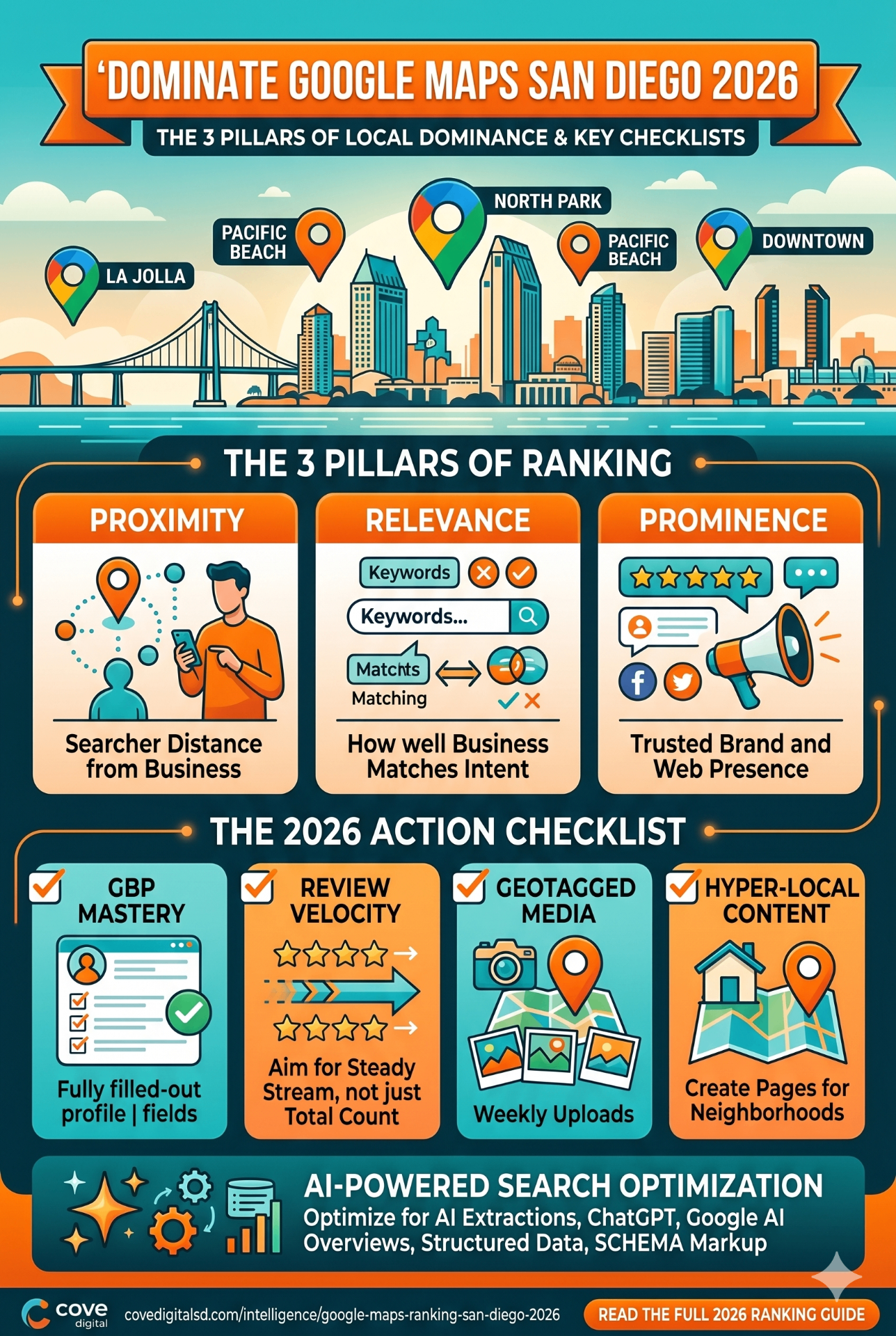
Dominate Google Maps San Diego 2026 — the 3 pillars of local ranking (proximity, relevance, prominence) and the 2026 action checklist (GBP mastery, review velocity, geotagged media, hyper-local content) plus AI-powered search optimization.
The 3 pillars of San Diego local dominance and the 2026 action checklist.
01

Beyond Proximity: The Neighborhood Matrix

Google has moved past 'near me' searches. The algorithm now uses Neighborhood Salience to determine authority. To rank for high-value terms in Sorrento Valley, your digital footprint must be mathematically tied to the biotech corridor — even if your physical office is slightly outside the search radius.

The Strategy

We deploy Geofenced Schema that anchors your business coordinates to specific San Diego landmarks (the San Diego Convention Center, Balboa Park, the Otay Mesa Port of Entry). This tells the algorithm that your business is not just at an address, but is an integral node of that neighborhood's commerce.

02

N-Gram Sentiment & Review Engineering

The number of stars on your profile is a vanity metric. In 2026, Google's Natural Language Processing (NLP) engine deconstructs your reviews into N-Grams — specific clusters of words. If you are a San Diego defense contractor and your reviews only say 'great service,' you will not rank. The algorithm is looking for technical tokens like 'ITAR compliance,' 'NAVWAR contract fulfillment,' or 'precision machining.'

The Strategy

We implement an N-Gram Review Strategy, training your clients to provide feedback that contains the specific semantic tokens the algorithm needs to verify your industry expertise.

03

The 'Answer Engine' Integration

Google Maps is no longer a standalone product; it is an extension of Google Gemini. When a user asks their AI agent, 'Find me a highly-rated family law firm in Downtown San Diego that specializes in high-asset divorce,' the AI doesn't just look at the Map Pack. It looks for Citation Probability.

The Strategy

We use Generative Engine Optimization (GEO) to ensure your Map Profile and your website are perfectly synced. We align your Entity Attributes so AI agents cite your Map location as the definitive answer to complex, conversational queries.

The 2026 Local Reality

A business ranking #1 on the map is no longer the result of "good luck." It is the result of Structural Feature Engineering. If your business is currently losing local market share, it is because your digital entity lacks the geospatial anchors required by modern AI search engines.

AI-Optimized FAQ

2026 Google Maps Strategy

Audit Your Visibility

Are you invisible to the San Diego market? Stop guessing at your local strategy. Apply for our AI Visibility and Revenue Leakage Audit. We will simulate your Map Pack performance and show you exactly where competitors are intercepting your revenue.

Apply for the AI Audit